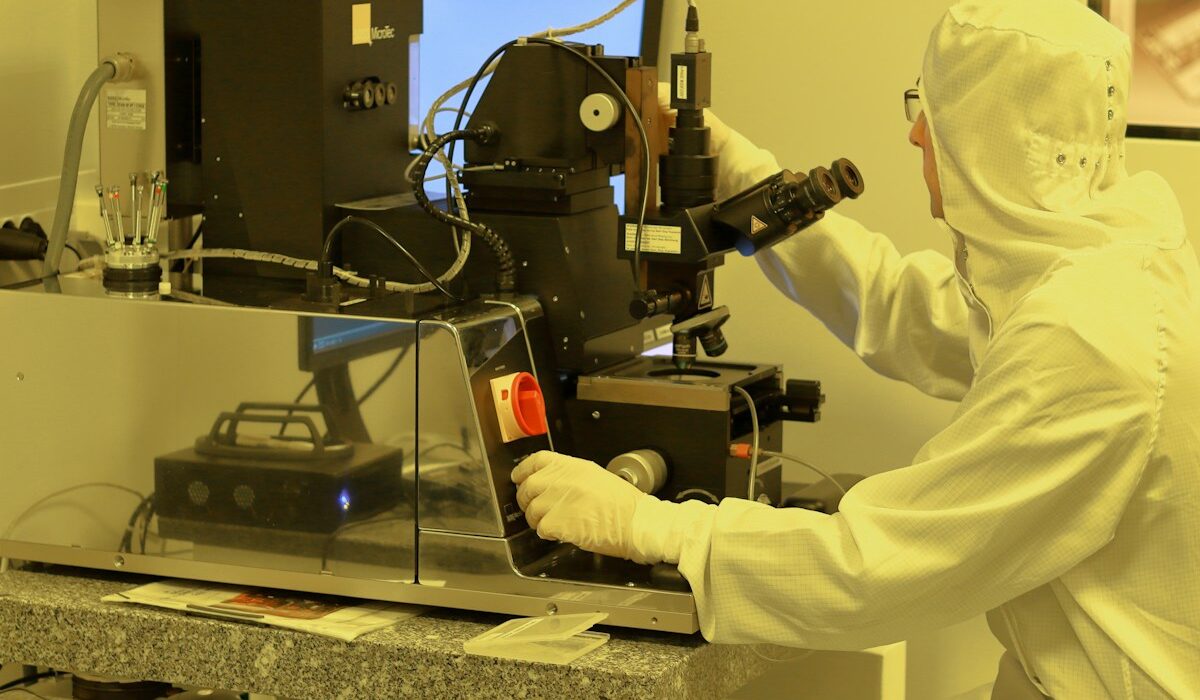
NVIDIA AI-defined fabs are expanding as semiconductor companies adopt CUDA-X libraries for chip design, manufacturing and inspection. NVIDIA announced the new deployments at SEMICON West on October 14, 2026.
The rollout includes cuPotential, an early-access library that helps AI agents model atomic and molecular interactions. NVIDIA and its partners also reported acceleration across lithography, wafer-etch simulation, packaging design and factory quality control.
NVIDIA AI-defined fabs add cuPotential
The NVIDIA announcement describes AI-defined fabs as semiconductor plants where AI helps engineers optimize processes, diagnose production issues and improve efficiency. The company said cuPotential adds specialized GPU functions for modeling electrical forces and other atomic interactions.
NVIDIA reported an additional two-to-three-times acceleration in early-access tests of workflows already optimized for GPUs. Synopsys is among the early adopters and is combining cuPotential with cuEST and cuDSS for materials and device simulations.
The strategy extends AI infrastructure beyond model serving into the process of building chips. That creates a feedback loop with custom accelerators such as Microsoft Maia 300, which depend on advanced manufacturing capacity while increasing demand for efficient inference hardware.
Chipmakers report faster simulations and inspection
Synopsys reported potential speedups of 30x in early QuantumATK results using cuEST and 12x in S-Device benchmarks using cuDSS. Cadence said its AuraStack AI Super Agent optimized advanced packaging for heat and stress eight times faster with cuDSS and Cadence Celsius.
Lam Research plans to integrate the open-source NanoVDB library into SEMulator3D. The company expects the change to accelerate selected wafer-etch modeling by as much as 30x. NVIDIA said PhysicsNeMo has reduced some plasma-prediction simulations from days to milliseconds.
Inspection and testing produced additional partner-reported gains. KLA achieved a new image-processing kernel that ran 50x faster than earlier CPU versions, while Teradyne reported roughly 85x faster probe-maintenance inference. These figures come from selected company tests and do not represent a universal improvement across every fab workload.
Why NVIDIA AI-defined fabs matter for capacity
Semiconductor production requires thousands of process steps before a chip reaches final testing. Digital twins and accelerated solvers can let engineers test design or equipment changes before applying them to expensive physical lines.
Applied Materials said NVIDIA libraries enabled up to 35x faster chamber simulations and supported digital twins for factory layouts and material flows. Other participants include Siemens, COMSOL, KLA, Cadence, Synopsys, Analog Devices, Foxconn and FANUC.
The push arrives as manufacturers expand fabrication capacity and advanced packaging. Our coverage of the GlobalFoundries fab plan shows how capital spending and public incentives are also shaping semiconductor supply.
Availability and investor limits
cuPotential is available in early access. NanoVDB is open source within OpenVDB, while NPP is included in the NVIDIA CUDA Toolkit. Lam Research targets release of its NanoVDB-accelerated SEMulator3D capability by the end of 2026.
For investors, the announcement demonstrates how NVIDIA is extending its software stack into semiconductor engineering. However, partner benchmarks cover different tasks, hardware and test conditions, so the published gains should not be compared as a single performance ranking.
The commercial effect will depend on adoption, integration costs and whether faster simulation improves production yields. Investors can review the underlying demand mechanics in our AI inference explainer, which examines how token workloads translate into chip and data-center requirements.

Elsy kanana
Elsy Kanana is a financial and cryptocurrency journalist at FusionMarketNews, covering digital assets, blockchain technology, financial markets, and emerging fintech trends. Her reporting focuses on market movements, regulatory developments, and on-chain analytics, delivering clear, data-driven insights to readers worldwide.