Asia-Pacific semiconductor supply chains are preparing for faster artificial intelligence infrastructure growth, with logistics speed and manufacturing diversification emerging as priorities in a new industry survey. The FedEx and Frost & Sullivan report, published October 23, 2026, surveyed 478 participants at SEMICON Taiwan from September 2 through September 4.
Key Insights
- APAC accounts for about 58% of global semiconductor industry revenue, according to the FedEx report.
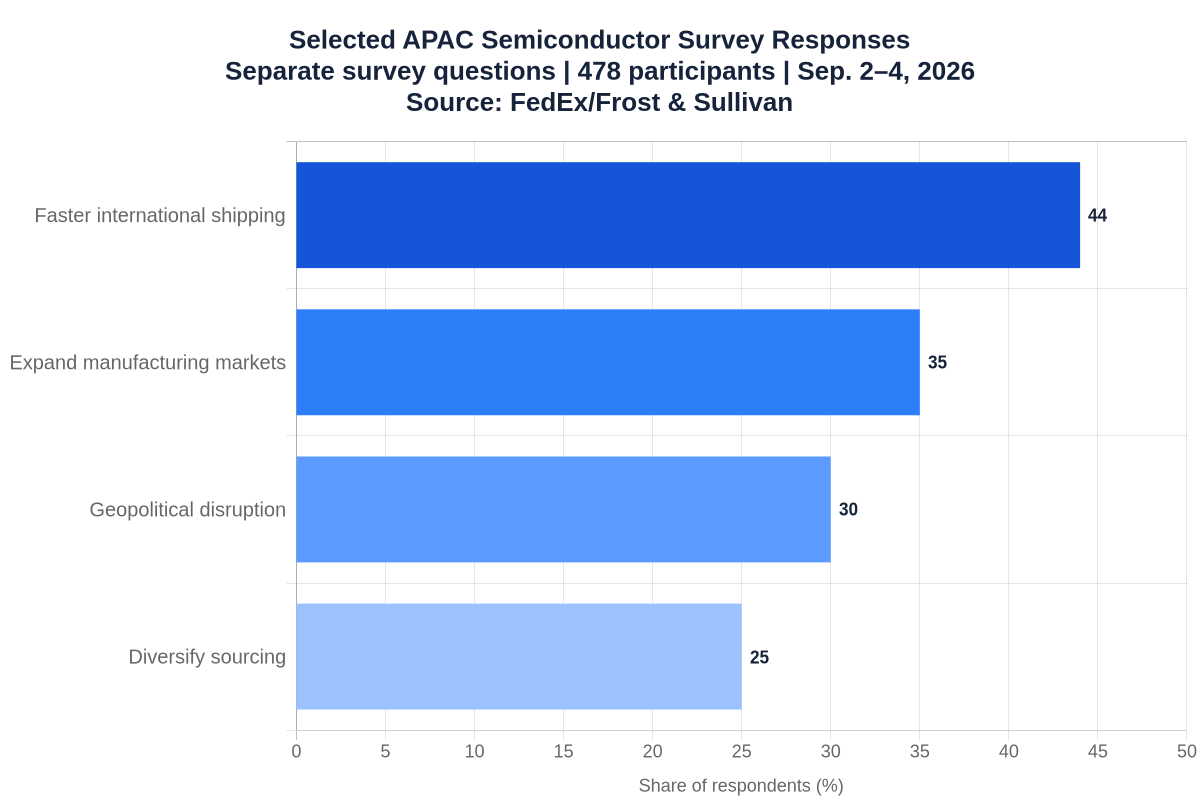
- Forty-four percent of surveyed participants prioritize faster international shipping, while 35% expect to expand manufacturing into additional APAC markets.
- Thirty percent name geopolitical disruption as their top growth challenge, and 25% plan to increase or diversify sourcing.
AI Demand Reshapes Chip Logistics
The report links semiconductor demand to expanding cloud capacity, AI accelerators and data-center construction. It estimates that more than 2,000 new data centers will be added globally between 2026 and 2035. That buildout raises the value of predictable transport for high-value components, production tools and time-sensitive replacement parts.
Mainland China represents more than half of APAC semiconductor revenue and nearly 30% of the global total, the report said. Taiwan remains central to advanced manufacturing, accounting for about 60% of worldwide foundry output. Those concentrations make regional logistics performance relevant to technology companies far beyond Asia.
Survey Shows Diversification Plans
Nearly four in five respondents identified markets across Mainland China, Hong Kong, Taiwan, Southeast Asia or Japan as offering the strongest demand growth over the next three years. At the same time, 35% expect to add manufacturing operations in more APAC markets and 25% plan to broaden sourcing. The figures come from separate survey questions and should not be added together.
Manufacturing shifts could reinforce the region’s broader digital expansion. Southeast Asia’s digital economy has reached $368 billion, while a new physical AI growth lab backed by Microsoft and Nvidia is targeting startups that connect software models with industrial systems. Both trends can increase demand for chips, sensors and reliable cross-border delivery.
What Markets Should Watch
The survey is a directional industry snapshot rather than a forecast of semiconductor sales or freight volumes. Still, the responses identify measurable operational priorities: 44% want faster international shipping, and 30% view geopolitical disruption as the leading challenge to growth. Investors can watch whether capital spending, factory announcements and logistics capacity follow those stated plans.
Power availability will also shape where data centers and chip production expand. Google’s plan to scale a Voltus virtual power plant to 1 gigawatt illustrates how technology companies are pairing AI growth with more flexible electricity supply. In APAC, similar infrastructure constraints could determine which markets capture the next round of semiconductor investment.

Elsy kanana
Elsy Kanana is a financial and cryptocurrency journalist at FusionMarketNews, covering digital assets, blockchain technology, financial markets, and emerging fintech trends. Her reporting focuses on market movements, regulatory developments, and on-chain analytics, delivering clear, data-driven insights to readers worldwide.