U.S. TIC inflows reached $199.8 billion in August 2026, according to a U.S. Treasury release published on October 16. The monthly data show that strong foreign demand for long-term securities outweighed declines in Treasury bill holdings and banking liabilities.
U.S. TIC Inflows Rebound in August
The August total marked the strongest monthly reading in the latest four-month run. Net inflows were $131.3 billion in May, $133.1 billion in June and $87.4 billion in July before accelerating to $199.8 billion in August.
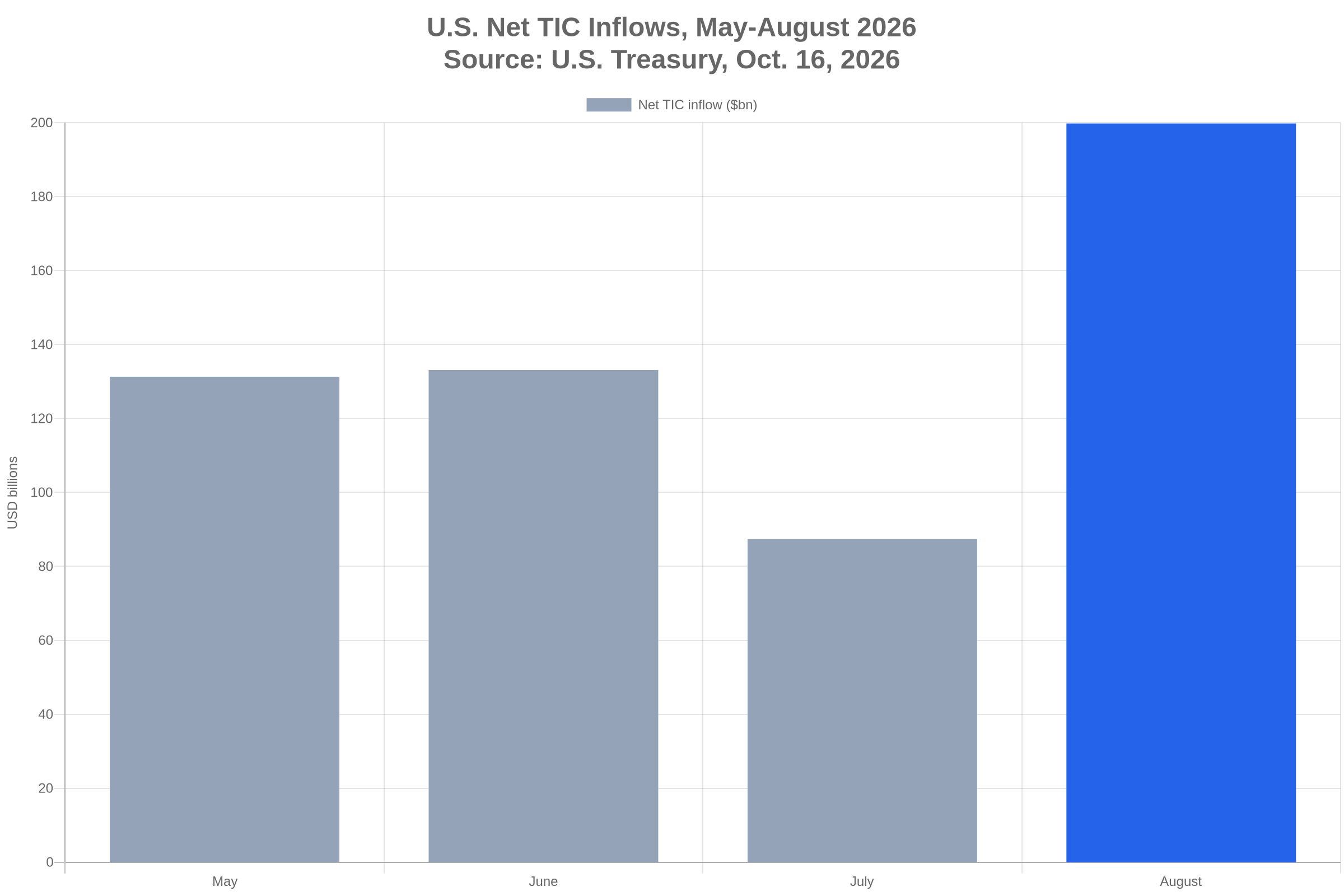
The Treasury separated the August event period from the October publication date. Its official TIC release also said net foreign private inflows were $178.5 billion and net foreign official inflows were $21.3 billion. The September report is scheduled for November 18.
Long-Term Demand Did the Heavy Lifting
Foreign private investors accounted for most of the $300.7 billion in net purchases of long-term U.S. securities, while foreign official institutions contributed $42.9 billion. U.S. residents, meanwhile, made $21.6 billion in net purchases of foreign long-term securities.
After adjusting for estimated foreign portfolio acquisitions of U.S. securities that are not captured in the standard transactions data, overall net foreign purchases of long-term securities were $279.2 billion. The large long-term total shows why the headline balance remained positive even as shorter-term positions weakened.
What U.S. TIC Inflows Signal
The August figures point to continued international demand for U.S. long-duration assets, but they do not measure every form of capital movement. TIC data can also attribute holdings to financial centers or custodians rather than the ultimate investor, so one month should not be read as a complete map of global demand.
For investors, the composition matters as much as the headline. The shift toward long-term securities may support market liquidity even when bill and bank flows turn negative. That distinction complements the Federal Reserve’s new private-credit data initiative, the IMF’s recent market-correction warning and the FCA’s benchmark regulation update.

Elsy kanana
Elsy Kanana is a financial and cryptocurrency journalist at FusionMarketNews, covering digital assets, blockchain technology, financial markets, and emerging fintech trends. Her reporting focuses on market movements, regulatory developments, and on-chain analytics, delivering clear, data-driven insights to readers worldwide.