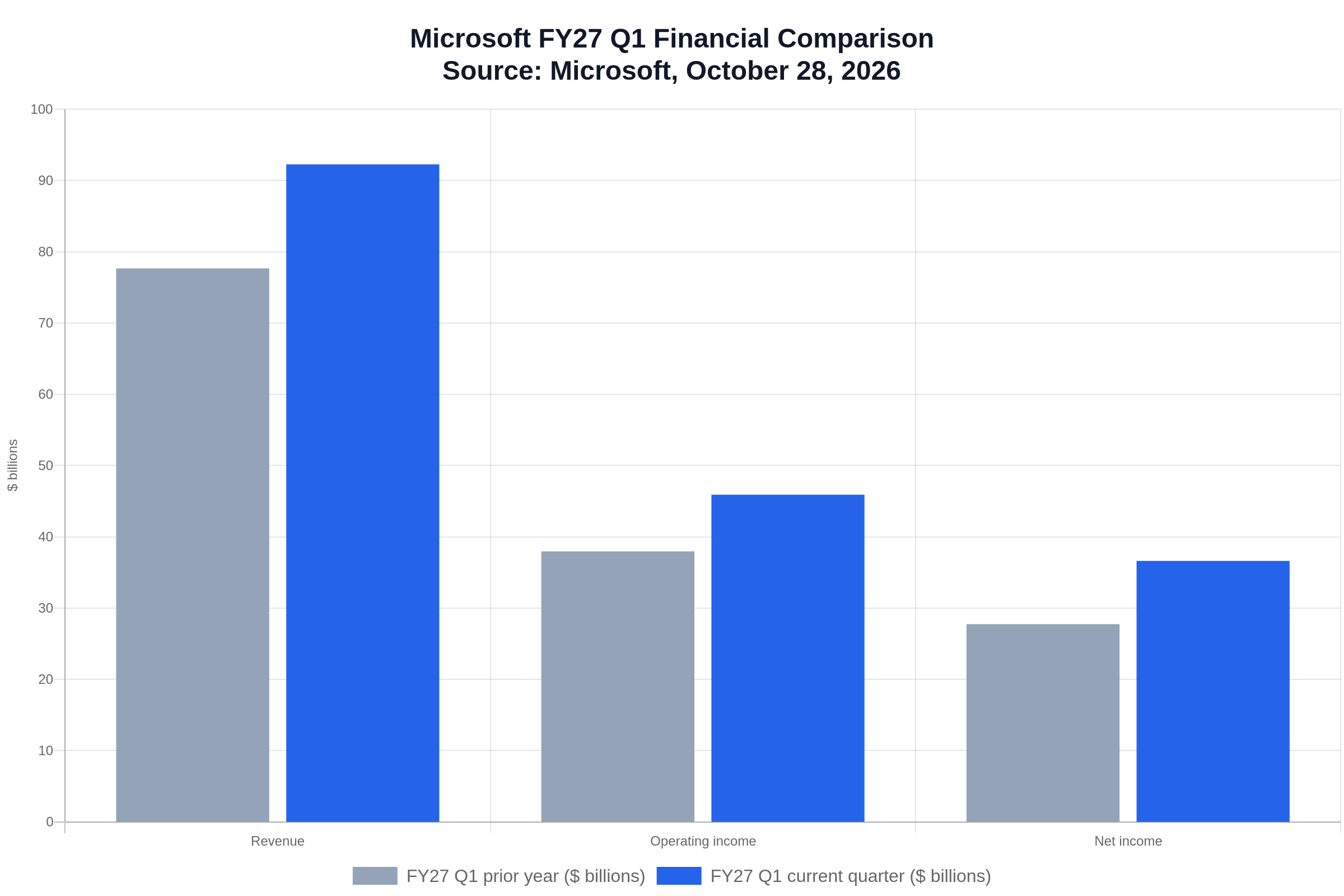
Microsoft earnings accelerated in its fiscal first quarter as Azure and broader cloud demand lifted revenue and profit. The company reported $92.28 billion in revenue for the quarter ended September 30, up 19% from a year earlier, in its official October 28 release.
Operating income increased 21% to $45.92 billion, while GAAP net income rose 32% to $36.63 billion. Diluted GAAP earnings per share increased 32% to $4.92.
Microsoft Earnings Get a 48% Azure Lift
Microsoft Cloud revenue reached $63.9 billion, rising 30% year over year. Azure revenue grew 48%, making cloud infrastructure the clearest driver of the quarter’s expansion.
The company’s Agents and Infra segment generated $76.8 billion in revenue, up 25%. Commercial remaining performance obligations climbed 73% to $677 billion, providing a large base of contracted revenue that has not yet been recognized.
Cloud Growth Offsets Consumer Weakness
Microsoft 365 commercial cloud revenue rose 17% on a reported basis, while consumer cloud revenue also increased 17%. Search and advertising revenue excluding traffic-acquisition costs grew 12%.
Devices and Consumer revenue declined 3% to $15.48 billion. Windows OEM and Devices revenue fell 22%, and Xbox content and services revenue slipped 2%. The mixed result shows that cloud expansion outweighed weaker hardware and gaming trends.
Demand for AI infrastructure has also supported adjacent suppliers. Recent results showed AI storage demand lifting Silicon Motion and NXP revenue reaching $3.79 billion. Microsoft’s report places those hardware trends within a much larger cloud-services market.
OpenAI Investment Changes the Profit Comparison
Microsoft said its OpenAI investment added $207 million to current-quarter GAAP net income. A year earlier, the investment reduced net income by $3.09 billion, making the reported 32% profit increase less comparable across periods.
Excluding the investment impact, non-GAAP net income rose 18% to $36.42 billion and adjusted diluted EPS increased 18% to $4.89. The company returned $10.2 billion to shareholders through dividends and repurchases.
Investors will watch whether Azure maintains its pace as infrastructure spending expands. Corporate AI adoption remains broad—an earlier industry survey found AI use across 86% of UK financial firms—but high capital requirements make revenue conversion and margins central to the outlook.

Sharron Kendi
Sharron Kendi is a seasoned crypto market analyst and writer with over three years of experience decoding blockchain trends, price movements, and market dynamics. She holds a Bachelor’s Degree in Commerce (Finance) from Kenyatta University, blending a solid academic foundation with a sharp eye for technical analysis and a deep understanding of on-chain data. Her work delivers clear, data-driven insights that empower investors to navigate the fast-evolving digital asset space with confidence.