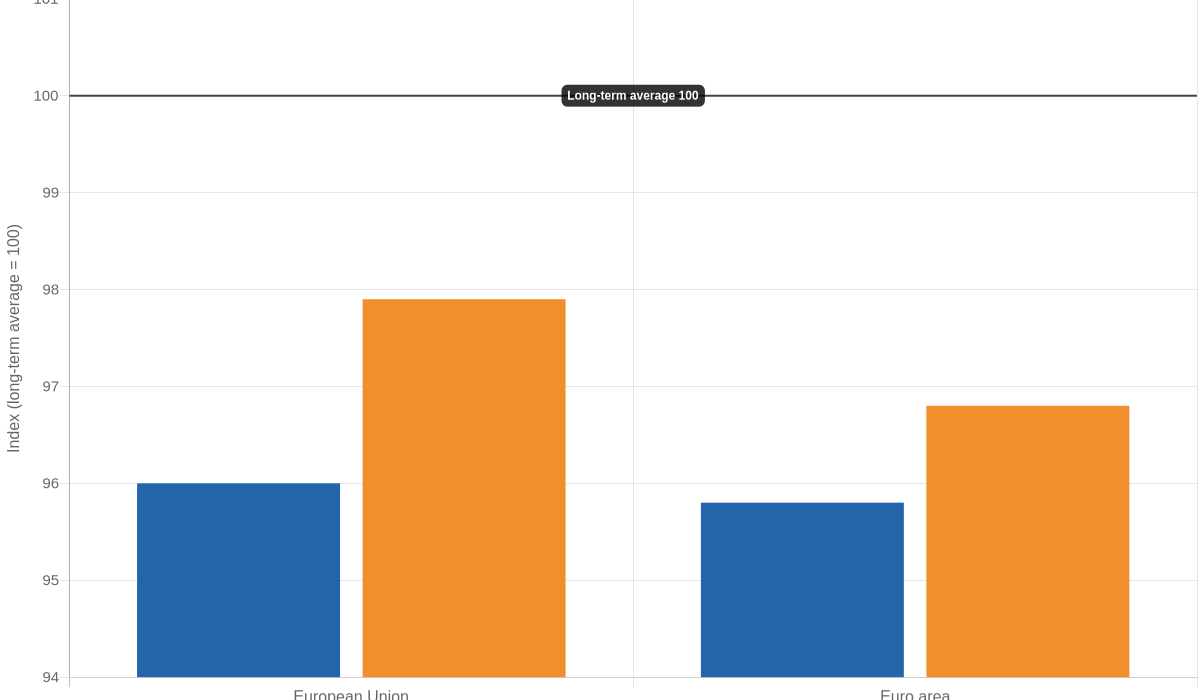
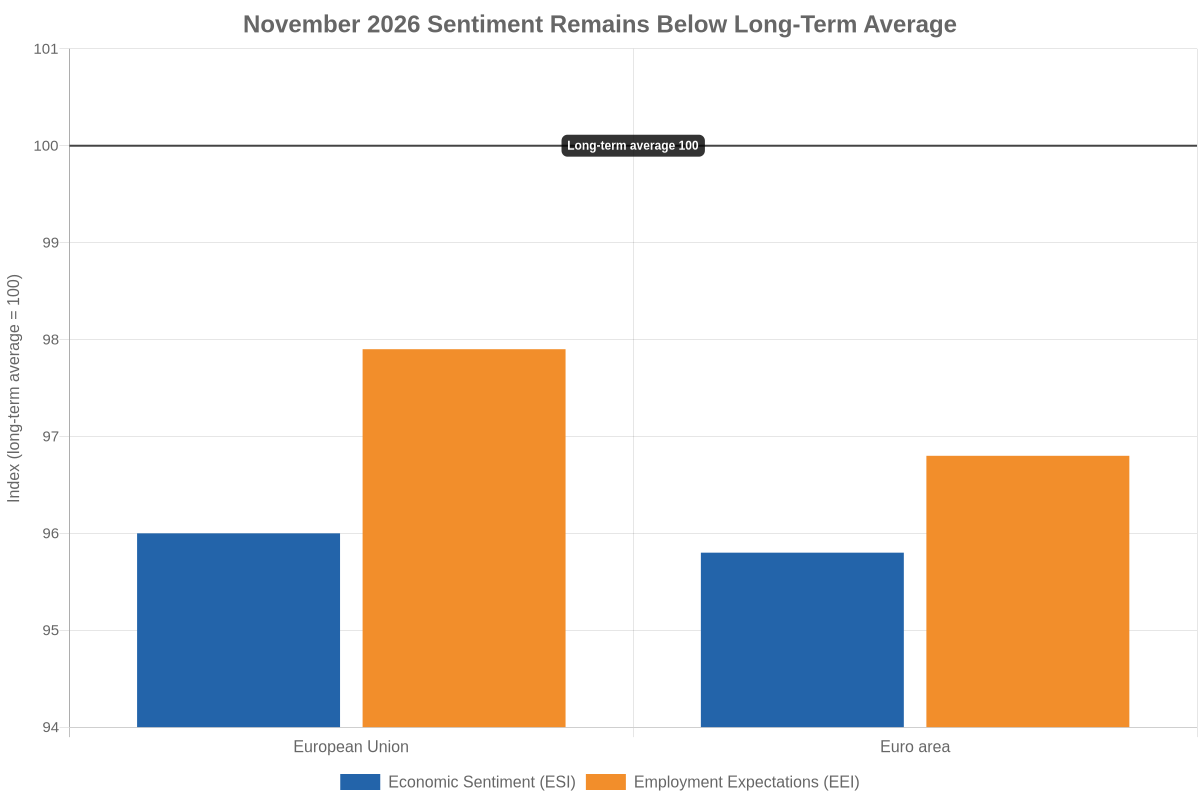
European economic sentiment weakened again in November, keeping business and labor expectations below their long-term norms. The European Commission’s November survey put the Economic Sentiment Indicator at 96.0 in the European Union and 95.8 in the euro area, with 100 representing the long-term average.
Key Insights
- EU economic sentiment fell 0.5 point to 96.0, while the euro-area reading dropped 0.7 point to 95.8.
- Employment expectations declined to 97.9 in the EU and 96.8 in the euro area, both below the 100 long-term average.
- Industry and construction drove the weaker EU headline, while consumer and retail confidence improved.
Sentiment and employment expectations lose ground
The Commission released the results on November 27 after collecting most responses from November 1 through November 20. The Employment Expectations Indicator fell 0.6 point in the EU and 1.3 points in the euro area. Those readings point to softer hiring expectations even as the broader economy continues to show uneven credit growth, including the latest rise in euro-area corporate lending.
Industry weakness offsets better consumer confidence
EU industry confidence fell 1.0 point as production expectations and finished-goods stock assessments worsened. Construction confidence slipped 0.4 point and services confidence was broadly stable, down 0.1 point. Consumer confidence improved 0.8 point, while retail trade confidence rose 0.6 point.
Performance varied sharply across major economies. Sentiment improved 2.6 points in the Netherlands and 0.4 point in Germany, but fell 3.1 points in Italy and 2.3 points in France. Spain was broadly stable with a 0.3-point decline. The split reinforces the mixed picture already visible in household inflation expectations and in global real housing data.
What markets should watch next
The below-average ESI and EEI do not by themselves signal a contraction, because they summarize survey balances rather than output or employment levels. Still, a sustained decline would increase the importance of incoming production, inflation and labor-market data for European Central Bank policy expectations.
Price pressures also remain uneven. Selling-price expectations increased in services and construction, while consumers’ 12-month inflation expectations fell sharply in November. Investors should therefore separate weaker activity sentiment from sector-level pricing signals instead of treating the survey as a single directional indicator.
Primary source: European Commission Business and Consumer Survey Results, November 2026.

Sharron Kendi
Sharron Kendi is a seasoned crypto market analyst and writer with over three years of experience decoding blockchain trends, price movements, and market dynamics. She holds a Bachelor’s Degree in Commerce (Finance) from Kenyatta University, blending a solid academic foundation with a sharp eye for technical analysis and a deep understanding of on-chain data. Her work delivers clear, data-driven insights that empower investors to navigate the fast-evolving digital asset space with confidence.