
Euro area consumers raised their median inflation expectation for the next 12 months to 3.5% in October from 3.1% in September, according to the European Central Bank. Perceived inflation also climbed sharply, while longer-term expectations moved less.
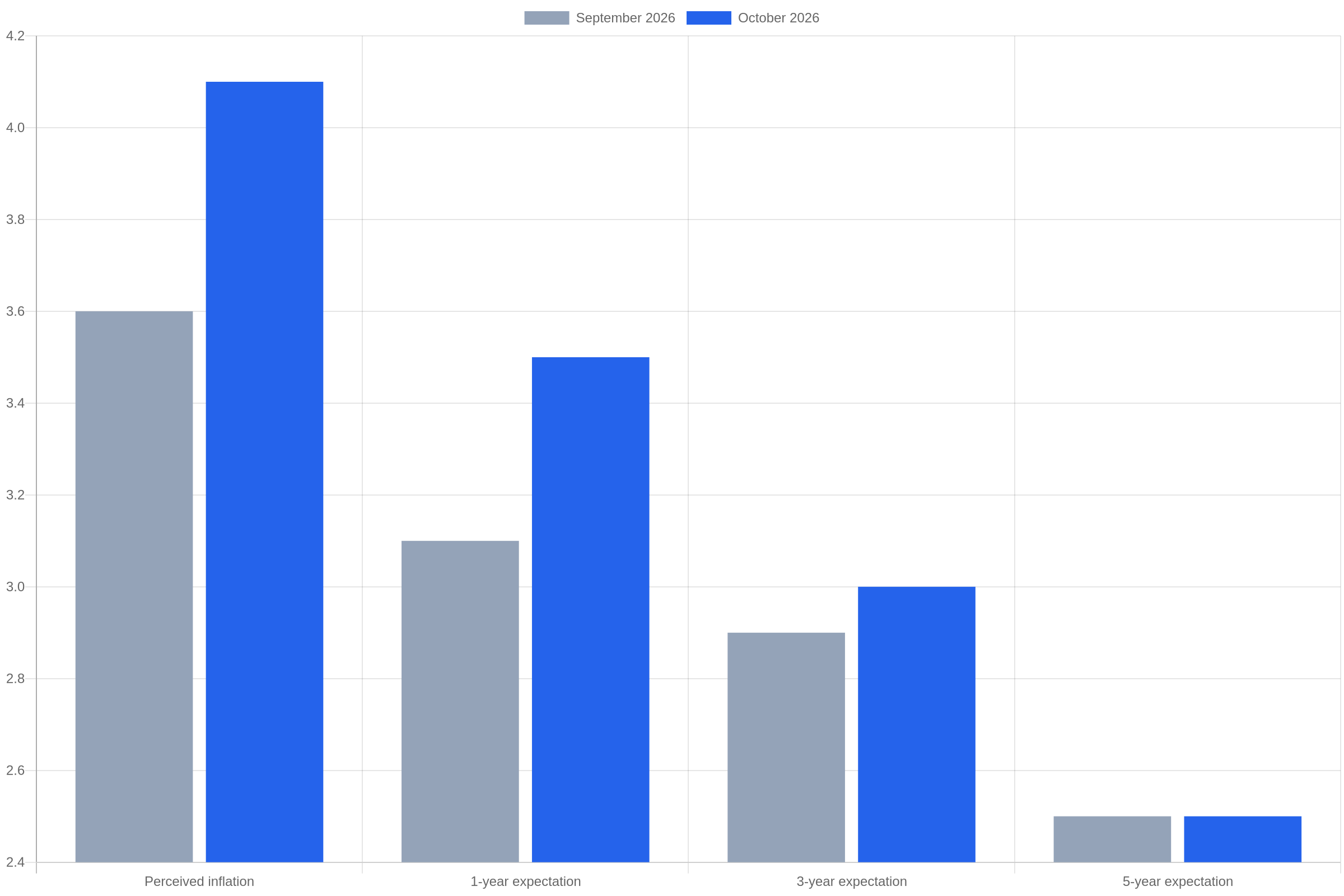
Near-term inflation expectations moved higher
The ECB published the October Consumer Expectations Survey results on November 27. Fieldwork ran from October 1 through November 2, so the survey period is separate from the publication date.
Consumers’ median estimate of inflation over the previous 12 months rose to 4.1% from 3.6%. Their one-year expectation increased by 0.4 percentage points to 3.5%, although it remained below the 4.0% reading recorded at the start of the Middle East conflict in March 2026.
The three-year expectation edged up to 3.0% from 2.9%. The five-year measure stayed at 2.5%, showing that the largest monthly change occurred in households’ near-term view rather than the longest horizon.
The survey complements other evidence on the euro area economy. Fusion Market News recently reported that euro area corporate loan growth accelerated to 4.5%, while the ECB’s monthly survey now shows households expecting faster price growth and tighter credit access.
Income expectations weakened as spending held steady
Expected nominal income growth over the next 12 months fell to 0.6% from 1.1%. The decline appeared across all income groups, while expected nominal spending growth remained unchanged at 3.7%.
That combination matters because households anticipate slower income gains without a matching reduction in spending growth. It can signal pressure on real purchasing power if the inflation expectations are realized.
Economic growth expectations improved modestly to minus 1.3% from minus 1.5%. The expected unemployment rate fell to 11.0% from 11.3%, while consumers continued to see the future unemployment rate only slightly above the perceived current rate of 10.4%.
Recent U.S. surveys have also shown mixed growth and price signals. The Federal Reserve’s November Beige Book found growth in eight districts alongside rising prices, and the Philadelphia Fed manufacturing survey showed weaker activity with higher price measures.
Housing and credit expectations point to restraint
Consumers expected home prices to rise 3.3% over the next year, down from 3.5% in September. Their expected mortgage interest rate remained 4.9%, while lower-income households continued to anticipate higher mortgage rates than higher-income households.
The net share of respondents expecting tighter credit conditions reached its highest level since October 2023. That result adds a financing constraint to the survey’s weaker income outlook, even as unemployment expectations improved.
The ECB said the monthly online survey covers about 19,000 adults in 11 euro area countries. The results support policy analysis but do not represent the views of the ECB’s governing bodies or staff. The next survey release, covering November, is scheduled for January 7, 2027.
Primary source: European Central Bank, “Consumer Expectations Survey results – October 2026,” published November 27, 2026.

Sharron Kendi
Sharron Kendi is a seasoned crypto market analyst and writer with over three years of experience decoding blockchain trends, price movements, and market dynamics. She holds a Bachelor’s Degree in Commerce (Finance) from Kenyatta University, blending a solid academic foundation with a sharp eye for technical analysis and a deep understanding of on-chain data. Her work delivers clear, data-driven insights that empower investors to navigate the fast-evolving digital asset space with confidence.