Key Insights
- Union Pacific reported record third-quarter net income of $2.076 billion, up 16% from a year earlier.
- Revenue rose 15% to $7.2 billion as revenue carloads increased 6%.
- The railroad kept its high-single-digit 2026 earnings-growth outlook and raised its capital plan to $3.5 billion.
Union Pacific’s third-quarter results paired higher freight volumes with double-digit profit growth, extending a strong year for the largest U.S. freight railroad by route miles. The company said the quarter ended Sept. 30, separating the operating period from its Oct. 22 results announcement.
Union Pacific Q3 2026 earnings beat last year
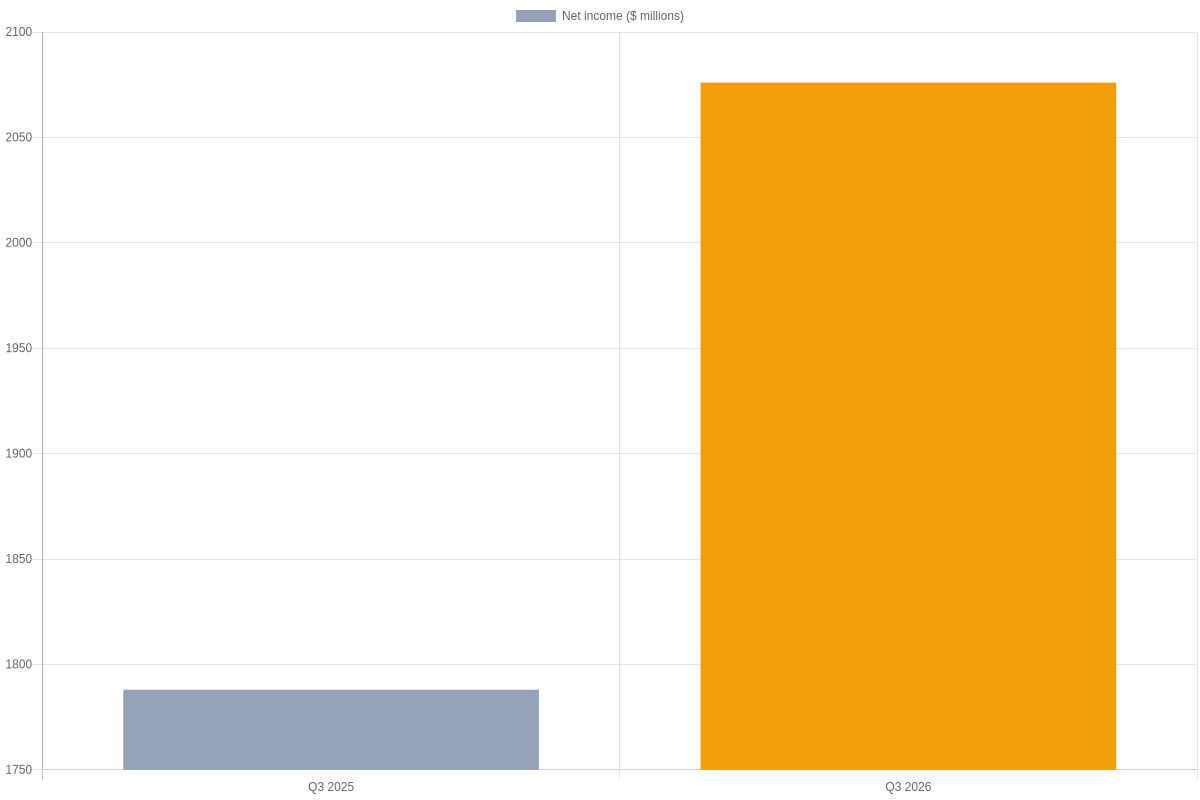
Union Pacific reported net income of $2.076 billion, or $3.49 per diluted share, compared with $1.788 billion and $3.01 per share a year earlier. Adjusted earnings reached $3.53 per share, up 15%, while operating revenue climbed 15% to $7.2 billion.
The net-income comparison is shown below using company-reported figures. Investors can also compare the report with CSX’s recent rail-volume update to gauge how demand and pricing are moving across the freight sector.
Efficiency gains offset fuel pressure
The reported operating ratio improved 10 basis points to 59.1%, even though higher fuel prices hurt the measure by 140 basis points. On an adjusted basis, the ratio increased 30 basis points to 58.8%, which signals modest underlying cost pressure despite stronger traffic.
Workforce productivity improved 5%, fuel consumption per gross ton-mile improved 2%, and average terminal dwell fell 2% to 19.9 hours. Those gains can support cash generation, which investors can assess with our free cash flow guide.
2026 outlook and capital spending
Management reaffirmed its expectation for high-single-digit reported earnings-per-share growth in 2026. Union Pacific also updated its capital plan to $3.5 billion, making spending discipline and network returns important watchpoints into year-end.
Capital investment supports capacity, safety and service, but it also competes with buybacks and dividends for cash. Readers can review the tradeoffs in our capital expenditure guide before the railroad’s next earnings update.

Elsy kanana
Elsy Kanana is a financial and cryptocurrency journalist at FusionMarketNews, covering digital assets, blockchain technology, financial markets, and emerging fintech trends. Her reporting focuses on market movements, regulatory developments, and on-chain analytics, delivering clear, data-driven insights to readers worldwide.