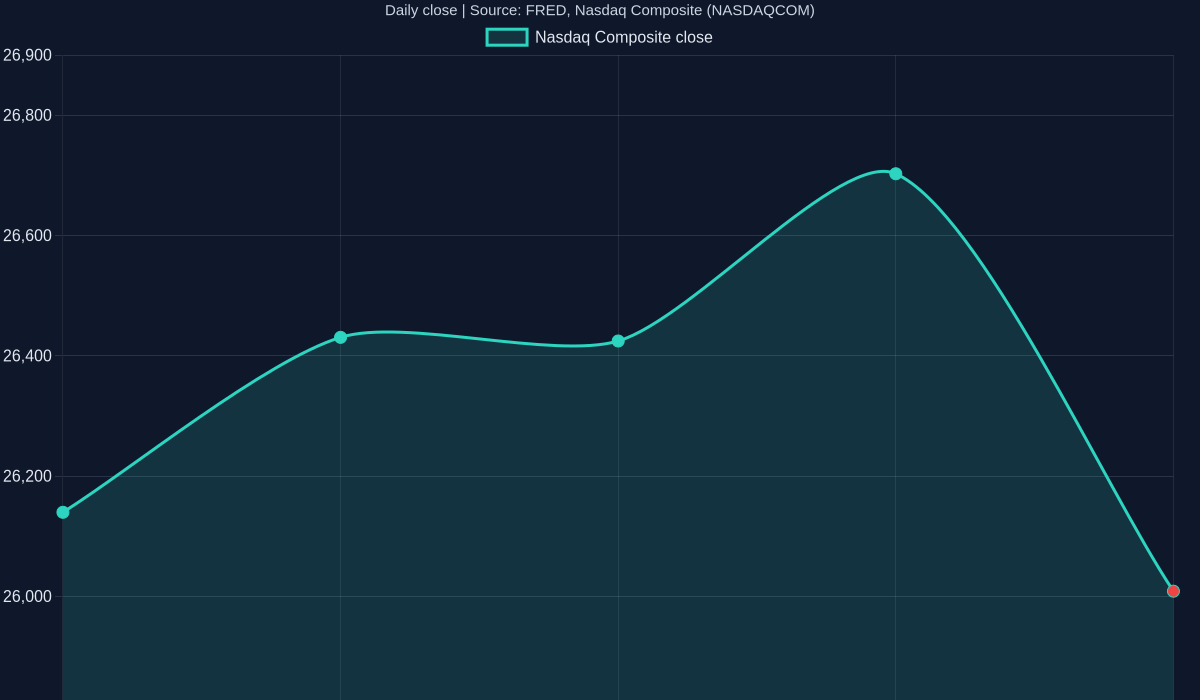
Nasdaq Composite losses accelerated on October 22, 2026, as the technology-heavy index closed at 26,008.86. The finish was 694 points below the previous session and represented a 2.60% daily decline.
The event date was October 22, while official Federal Reserve Economic Data was updated after the close. The move erased the index’s gains from earlier in the week and left it below the October 16 close of 26,140.03.

Nasdaq Composite records sharp daily reversal
FRED’s Nasdaq Composite series lists closes of 26,140.03 on October 16, 26,430.89 on October 19, 26,424.82 on October 20 and 26,702.86 on October 21. The October 22 close therefore marked a 2.60% retreat from the previous session and a 0.50% decline from October 16.
The Nasdaq Composite includes eligible domestic and international common stocks listed on the Nasdaq Stock Market. That broad technology exposure differs from the narrower Nasdaq-100, so the Composite’s move reflects more than the largest technology companies.
AI spending debate returns to technology stocks
Corporate results kept the cost of artificial intelligence investment at the center of market analysis. Meta’s third-quarter release narrowed its 2026 capital-expenditure outlook to $135 billion–$145 billion from $130 billion–$145 billion.
Large spending plans can support chip, cloud and data-center demand, but they also raise the earnings threshold companies must clear. Fusion Market News previously examined shared infrastructure programs in the Physical AI Growth Lab and the operational focus of the OpenAI Decisions API.
What Nasdaq Composite investors should watch
The next signal is whether selling remains concentrated in expensive growth stocks or expands across the wider market. Investors should also separate index-level weakness from company-specific results because capitalization-weighted benchmarks can move sharply when their largest components fall together.
Friday’s session may confirm whether October 22 was a one-day repricing or the start of a deeper pullback. Longer-term demand remains supported by digital adoption, including the Southeast Asia digital economy, but near-term valuations still depend on interest rates, margins and visible returns from AI spending.
This article is for informational purposes only and does not constitute financial advice. Stock indexes can move sharply, and readers should conduct independent research before making investment decisions.

Sharron Kendi
Sharron Kendi is a seasoned crypto market analyst and writer with over three years of experience decoding blockchain trends, price movements, and market dynamics. She holds a Bachelor’s Degree in Commerce (Finance) from Kenyatta University, blending a solid academic foundation with a sharp eye for technical analysis and a deep understanding of on-chain data. Her work delivers clear, data-driven insights that empower investors to navigate the fast-evolving digital asset space with confidence.