Key Insights
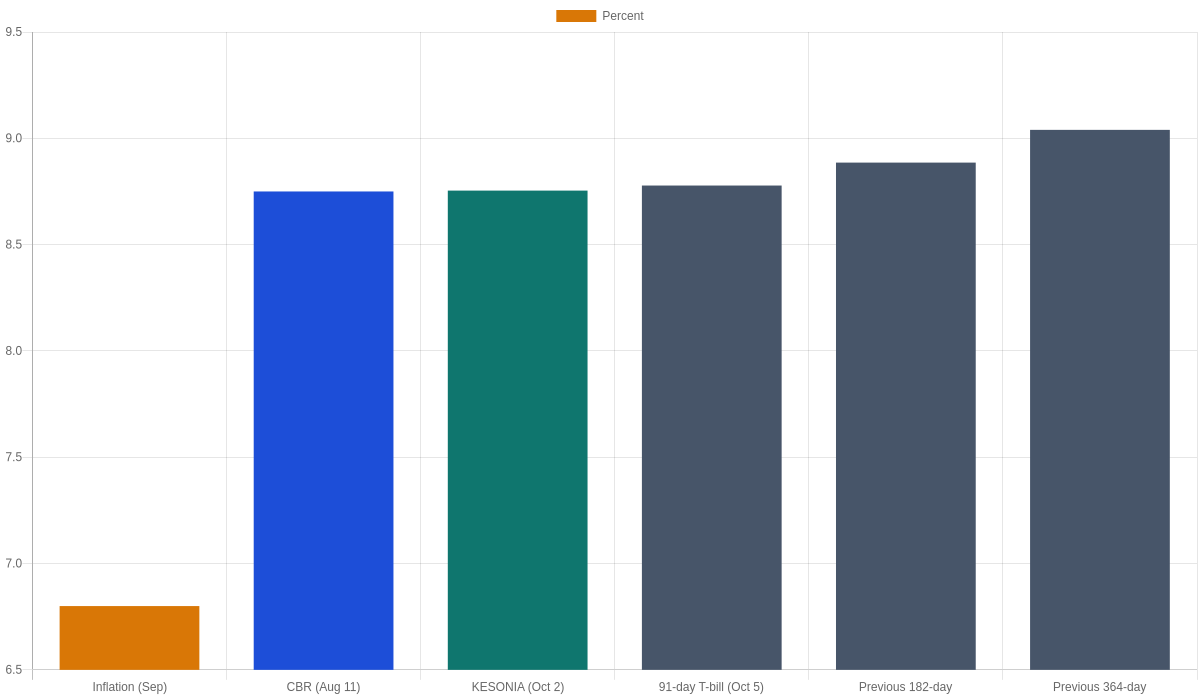
- Kenya’s interest rate decision arrives October 7 with the Central Bank Rate at 8.75%.
- September inflation rose to 6.8%, led by transport and food costs.
- Short-term government yields cluster near 8.8% to 9.0%, keeping cash returns above headline inflation.
Kenya’s interest rate decision on October 7 will test whether rising inflation outweighs stable money-market conditions. The Central Bank of Kenya enters the meeting with its policy rate at 8.75% and September inflation at 6.8%.
The decision matters beyond commercial-bank borrowing costs. It will shape Treasury-bill demand, the shilling outlook and expectations for lending-rate relief into year-end.
Kenya Interest Rate Decision Meets Faster Inflation
The Kenya National Bureau of Statistics reported annual inflation of 6.8% in September. That was up from the 6.6% rate shown for August on the CBK’s data dashboard.
Transport prices rose 15.6% from a year earlier. Food and non-alcoholic beverages increased 9.5%, while housing and utility costs advanced 3.2%.
Those three divisions represent more than 57% of the consumer basket. Their combined weight makes energy, transport and food costs central to the October decision.
Global fuel conditions remain relevant after the recent G7 oil reserve release plan. Supply risks around the Strait of Hormuz also influenced the earlier U.S.-Iran market outlook.
Money-Market Rates Give CBK Room to Wait
CBK data placed KESONIA, the overnight interbank benchmark, at 8.7541% on October 2. That reading closely matched the 8.75% Central Bank Rate.
This alignment suggests the operating framework is transmitting the policy setting into overnight funding. It does not, however, mean household and business credit has become inexpensive.
The CBK listed the average commercial-bank lending rate at 14.34% for August. Deposit rates averaged 6.91%, while savings rates stood at 3.54%.
The spread leaves policymakers balancing two pressures. A lower policy rate could support borrowers, but faster inflation could weaken the case for immediate easing.
Treasury Bills Set the Market’s Next Test
The CBK Treasury-bill page shows an auction scheduled for October 8, one day after the policy meeting. Previous average rates were 8.7694% for 91 days, 8.8856% for 182 days and 9.0397% for 364 days.
The CBK’s main dashboard separately listed the 91-day yield at 8.778% on October 5. These levels remain above September inflation, giving short-term government paper a positive nominal yield margin.
A policy surprise could change bidding behavior at the October 8 auction. Lower rate expectations may strengthen demand for existing higher-yield paper, while a hawkish signal could keep investors cautious.
The same rate-versus-inflation calculation affects global assets. Fusion’s recent analysis of Treasury yields and Bitcoin showed how changes in sovereign yields can quickly alter risk appetite.
Shilling Stability Remains the Third Signal
The CBK posted a reference rate of 129.76 shillings per U.S. dollar for October 2. A stable currency can limit imported inflation, particularly for fuel and other dollar-priced goods.
However, the latest inflation report shows domestic consumers still face faster transport and food costs. That weakens the case for judging policy conditions from the exchange rate alone.
The next observable catalyst is the CBK’s October 7 statement. Markets will then compare its inflation language with the October 8 Treasury-bill auction results and any change in short-term yields.

Elsy kanana
Elsy Kanana is a financial and cryptocurrency journalist at FusionMarketNews, covering digital assets, blockchain technology, financial markets, and emerging fintech trends. Her reporting focuses on market movements, regulatory developments, and on-chain analytics, delivering clear, data-driven insights to readers worldwide.