Capital One reported third-quarter 2026 net income of $3.5 billion, or $5.61 per diluted share, as revenue increased and its net interest margin widened. The result compared with $3.0 billion in the second quarter and $3.2 billion a year earlier, according to the company’s October 20 earnings release.
Key Insights
- Capital One net income rose to $3.5 billion, while adjusted diluted earnings reached $6.69 per share.
- Total net revenue increased 3% from the second quarter to $16.3 billion as net interest margin expanded 40 basis points to 8.41%.
- Period-end loans increased $5.4 billion to $462.5 billion, while deposits declined $3.6 billion to $480.7 billion.
Capital One Net Income and Revenue Increase
Capital One’s non-interest expense fell 2% sequentially to $8.9 billion, helping pre-provision earnings increase 10% to $7.5 billion. The provision for credit losses declined by $73 million to $2.9 billion and included $3.1 billion of net charge-offs and a $225 million loan-reserve release.
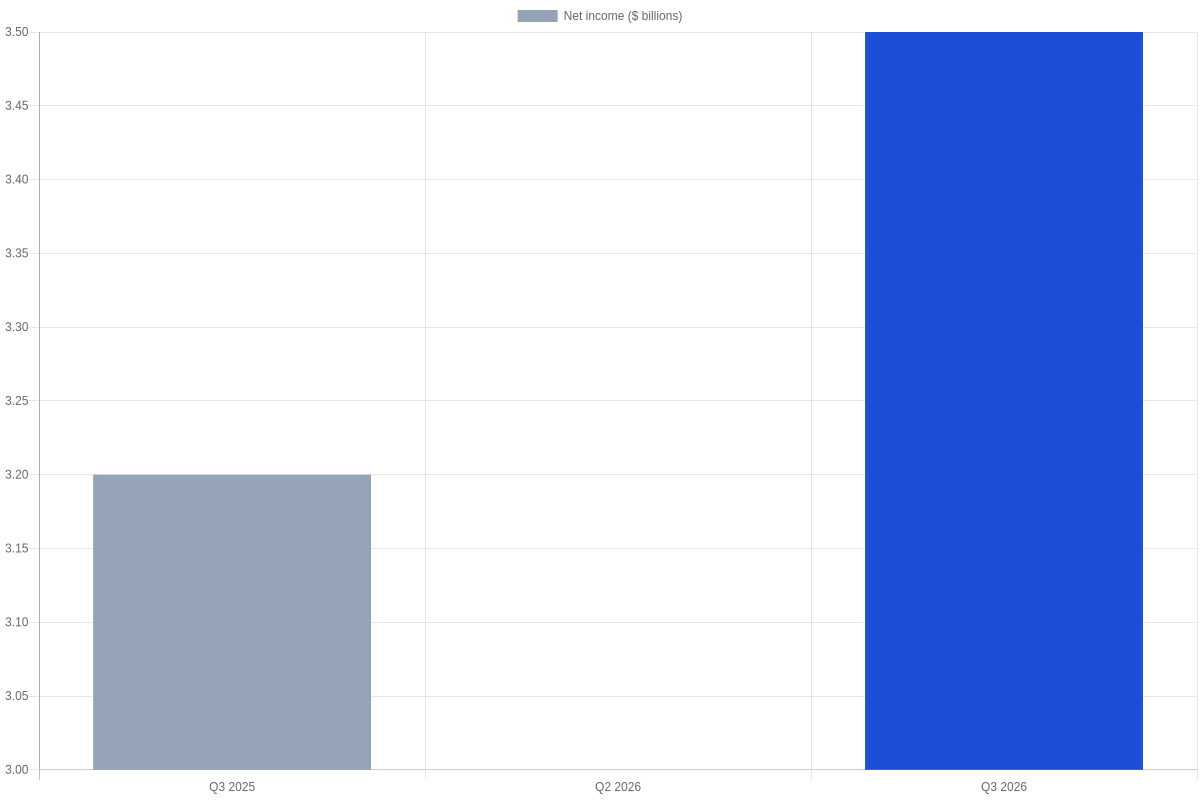
The chart uses the three comparable periods disclosed in Capital One’s release and shows reported net income, not adjusted net income. For context across financial-sector earnings, investors can compare the result with recent updates from Moody’s and Simmons Bank.
Loans Rise as Deposits Decline
Consumer banking loans increased $3.6 billion to $94.0 billion, driven mainly by auto lending, while credit-card loans rose by $952 million to $276.4 billion. Commercial banking loans grew $834 million to $92.1 billion, and the common equity Tier 1 ratio stood at 13.8% as of September 30.
Chief Executive Richard Fairbank said the Discover integration was progressing well and the company was making progress on expected synergies. The widening margin and loan growth support the earnings improvement, though lower deposits and credit costs remain important watchpoints alongside broader market activity tracked in CME Group’s record-volume quarter.

Sharron Kendi
Sharron Kendi is a seasoned crypto market analyst and writer with over three years of experience decoding blockchain trends, price movements, and market dynamics. She holds a Bachelor’s Degree in Commerce (Finance) from Kenyatta University, blending a solid academic foundation with a sharp eye for technical analysis and a deep understanding of on-chain data. Her work delivers clear, data-driven insights that empower investors to navigate the fast-evolving digital asset space with confidence.