AI stocks entered Q4 2026 with hyperscaler spending still accelerating across data centers. Microsoft, Alphabet and Meta outlined combined 2026 capital expenditure plans above $490 billion at the midpoint of their latest guidance ranges.
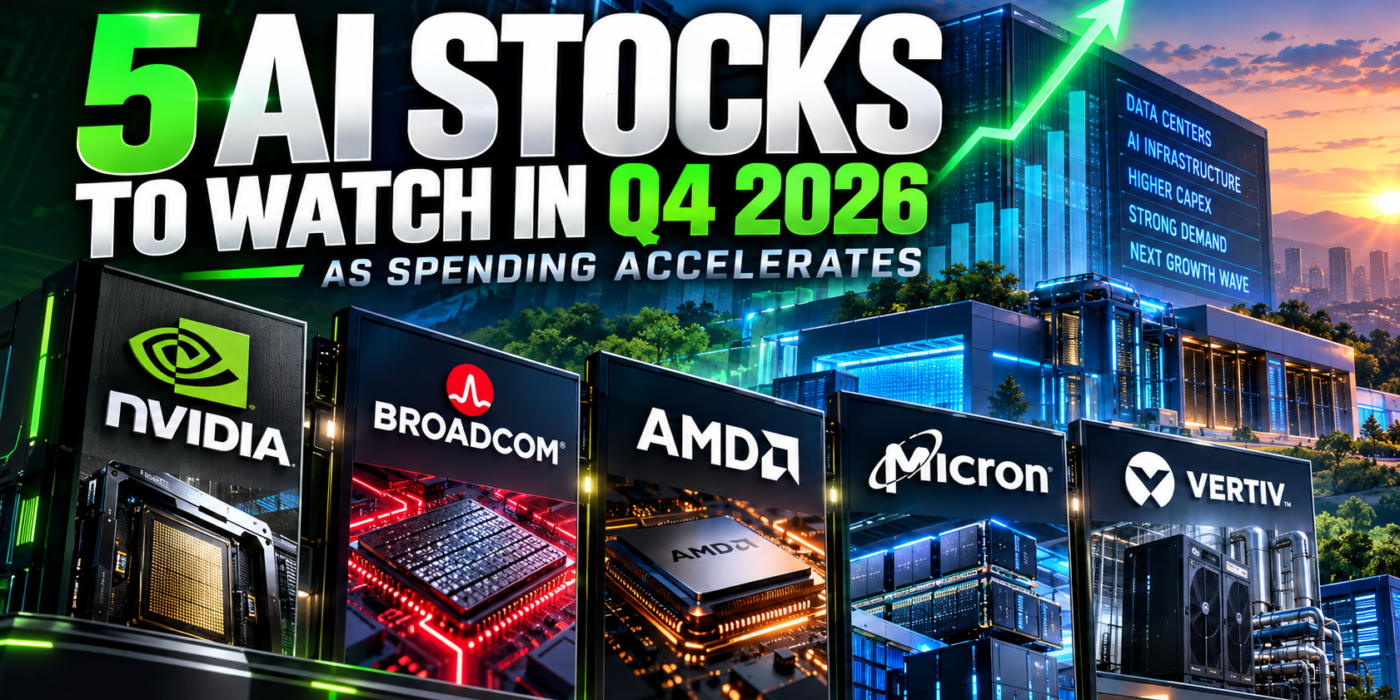
That spending supported several layers of the AI supply chain. Nvidia led accelerator demand, while Broadcom expanded custom silicon and networking exposure. AMD pushed for accelerator share, Micron supplied high-bandwidth memory, and Vertiv addressed power and cooling constraints.
- AI stocks entered Q4 with hyperscaler capital spending still near record levels.
- Nvidia, Broadcom and AMD reported sharp growth across AI chips and data-center businesses.
- Micron and Vertiv offered exposure beyond processors through memory, power and cooling.
The five stocks below were selected using reported AI exposure, recent revenue growth, Q4 catalysts and execution risks. Price alone did not determine inclusion.
| Stock | Latest relevant metric | Q4 focus |
|---|---|---|
| Nvidia | $89.0B Data Center revenue | Blackwell demand and margins |
| Broadcom | $16.7B AI semiconductor revenue | Custom accelerator growth |
| AMD | $6.7B Data Center revenue | Instinct and Helios deployments |
| Micron | $54.23B quarterly revenue | High-bandwidth memory supply |
| Vertiv | $3.27B quarterly net sales | Power and cooling demand |
AI Stocks Enter Q4 as Infrastructure Spending Accelerates
Microsoft said its calendar-year 2026 capital spending expectation remained near $175 billion after lease-accounting adjustments. Alphabet projected $175 billion to $185 billion, while Meta narrowed its outlook to $130 billion to $145 billion.
The spending cycle now reaches beyond graphics processing units. Servers, networking equipment, memory, data-center construction, cooling and power systems increasingly compete for the same capital budgets.
That backdrop also supports adjacent investment themes. Fusion Market News recently examined Applied Digital’s AI capacity buildout and a separate Q4 quantum-computing stock watchlist.
1. Nvidia Stock: AI Demand Meets Higher Expectations
Nvidia remained the most direct compute exposure among large-cap AI stocks. The company reported fiscal second-quarter revenue of $96.2 billion, up 106% from a year earlier, while Data Center revenue reached $89 billion and rose 117%.
Nvidia expected fiscal third-quarter revenue near $108 billion, plus or minus 2%. The forecast excluded Data Center compute revenue from China, according to the company’s Aug. 26 earnings release.
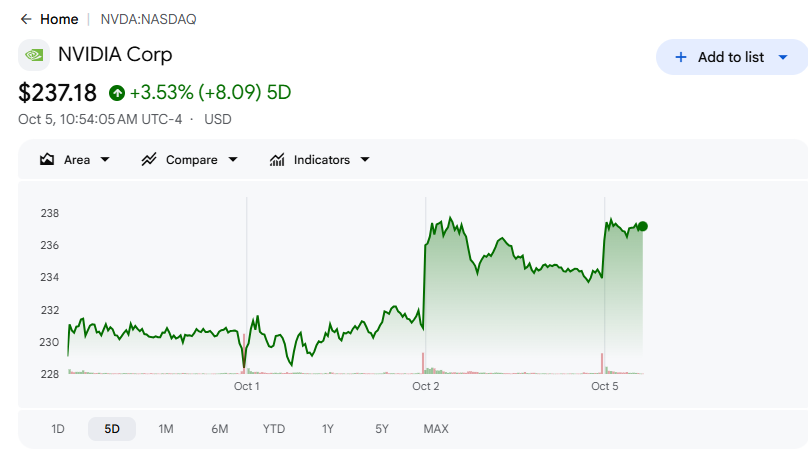
Nvidia traded near $237.18 on Oct. 5, while its five-day chart showed a 3.53% gain. The stock’s rise increased the earnings hurdle because investors already price in continued AI infrastructure growth.
The key tension is demand versus valuation. Blackwell and Vera Rubin deployments can sustain growth, but slower hyperscaler budgets, export restrictions or weaker gross margins would pressure the thesis quickly.
Nvidia also faces custom-chip competition from cloud companies and Broadcom, plus accelerating pressure from AMD. That does not remove its scale advantage, but it raises the standard for each earnings report.
2. Broadcom Stock: Custom AI Chips Capture More Spending
Broadcom provided a different route into AI stocks through custom silicon and networking. The company reported fiscal third-quarter revenue of $29.59 billion, up 86% year over year, while AI semiconductor revenue reached $16.7 billion.
Broadcom said AI semiconductor revenue rose 221% from a year earlier and 54% sequentially. Management forecast roughly $21.7 billion in AI semiconductor revenue for the fourth quarter, representing 236% annual growth.
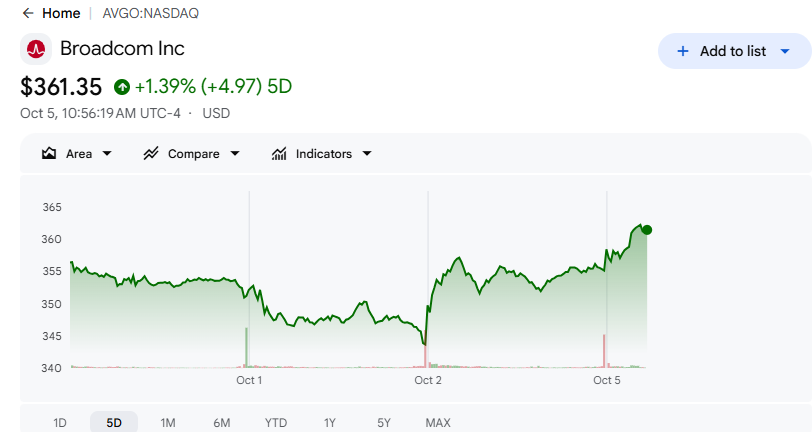
Broadcom traded near $361.35 on Oct. 5, with its five-day chart up 1.39%. The Q4 thesis centers on custom accelerators and networking rather than a direct replication of Nvidia’s graphics processor business.
Cloud companies increasingly design specialized chips for selected workloads. That gives Broadcom exposure to hyperscaler efforts to lower compute costs and reduce reliance on a single accelerator supplier.
The risk sits in customer concentration. A delayed program or weaker demand from a major hyperscaler could move revenue sharply because a limited number of customers drive the custom-silicon business.
3. AMD Stock: Data Center Growth Tests Nvidia’s Lead
Advanced Micro Devices entered Q4 as the clearest market-share challenger among these AI stocks. AMD reported second-quarter revenue of $11.54 billion, up 50%, while Data Center revenue rose 107% to $6.72 billion.
Data Center generated about 58% of company revenue during the quarter. AMD attributed the expansion to EPYC processors and Instinct accelerators, while its Helios rack-scale systems began moving into customer deployments.
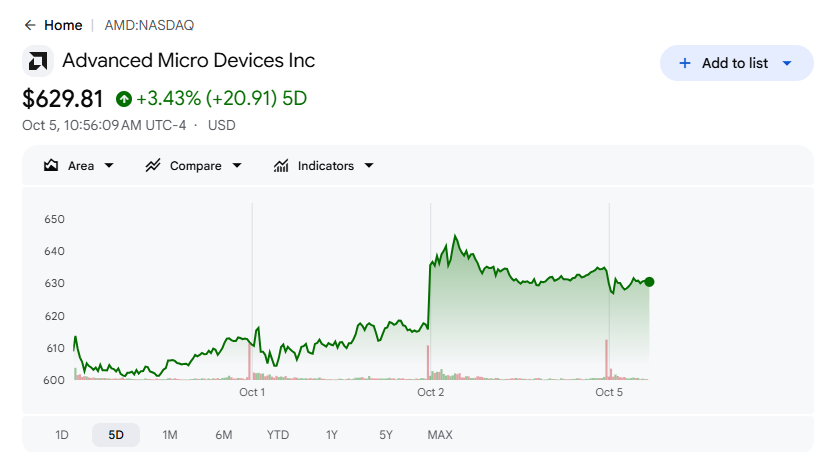
AMD traded near $629.81 on Oct. 5 after its five-day chart gained 3.43%. That price action reflected rising expectations for accelerator adoption and stronger second-half Data Center sales.
The upside depends on real deployment volume rather than benchmark claims. Customers named around Helios and Instinct span Microsoft, Meta, OpenAI, Oracle, Anthropic and other cloud operators.
AMD still competes against Nvidia’s larger software and installed-base advantages. Investors should therefore track Instinct shipments, Helios deployment timing and Data Center margins through Q4.
4. Micron Stock: Memory Becomes an AI Infrastructure Bottleneck
Micron shifts the AI stocks thesis away from processors. Modern AI servers require large volumes of high-bandwidth memory, making memory supply another constraint across the infrastructure chain.
Micron reported fiscal fourth-quarter revenue of $54.23 billion on Sept. 30. Revenue increased from $41.46 billion in the prior quarter and $11.32 billion one year earlier, while operating cash flow reached $43.97 billion.
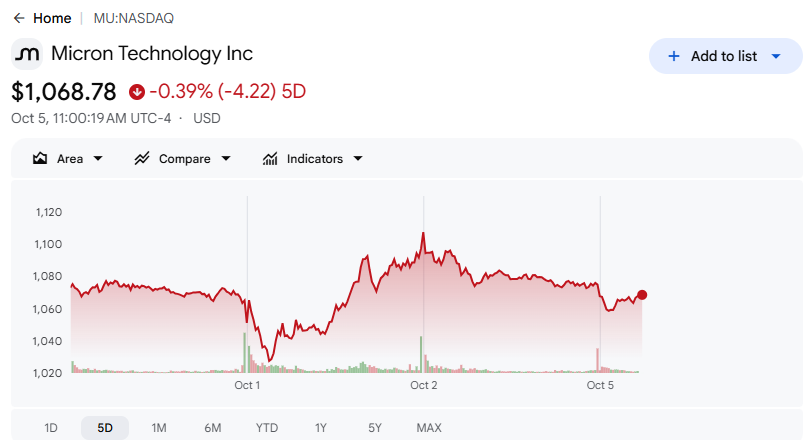
Micron traded near $1,068.78 on Oct. 5. Its five-day chart remained down 0.39%, showing that strong fundamentals did not remove short-term volatility after a rapid 2026 rally.
The investment case rests on sustained demand for high-bandwidth memory and disciplined industry capacity. Tight supply can support prices and margins, but high profitability also encourages memory producers to expand output.
That cyclical risk separates Micron from several other AI stocks. Investors should monitor memory pricing, new capacity and customer qualification schedules rather than relying only on headline revenue growth.
5. Vertiv Stock: AI Data Centers Face Power Constraints
Vertiv provides exposure to the physical infrastructure surrounding AI servers. Higher rack density increases electricity requirements and heat output, supporting demand for power-management and liquid-cooling systems.
Vertiv reported second-quarter net sales of $3.27 billion, up 24% from a year earlier. Operating profit rose 44%, while management lifted full-year net sales guidance to about $14 billion at the midpoint.
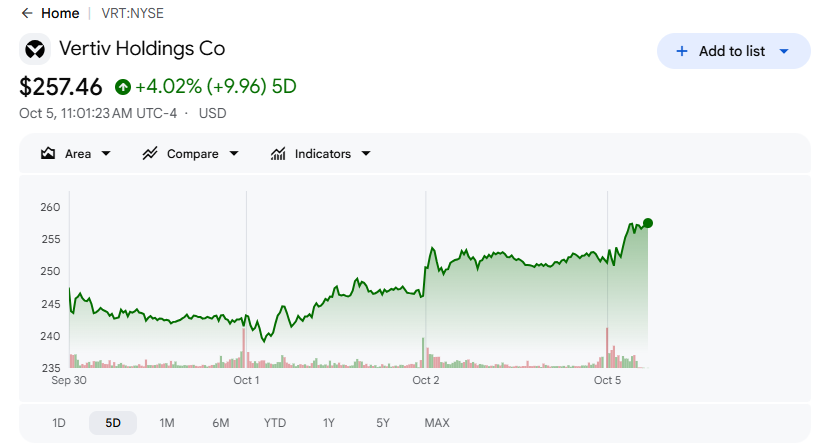
Vertiv traded near $257.46 on Oct. 5, while its five-day chart gained 4.02%. The move reflected continued investor focus on data-center bottlenecks outside the semiconductor market.
The company projected third-quarter revenue between $3.65 billion and $3.85 billion. Management also cited temporary supply-chain congestion and phased project execution as deployments increased in scale.
Those constraints create the central tension for Vertiv. Strong AI demand supports its order pipeline, but project timing and capacity expansion can create volatility even when end-market demand stays firm.
What Could Derail AI Stocks in Q4 2026?
The broad AI stocks thesis still depends on continued infrastructure spending. Microsoft said demand remained above available supply during its fiscal fourth-quarter earnings call, while Alphabet and Meta maintained large 2026 capital budgets.
However, higher spending also raises the return hurdle for cloud companies. Slower AI monetization, delayed data-center projects or weaker enterprise demand could eventually lead hyperscalers to reassess deployment schedules.
Valuation adds another risk. Nvidia, AMD, Micron and Vertiv entered Q4 after large 2026 gains, leaving less room for earnings misses or softer guidance.
Company-specific risks also differ. Nvidia faces export controls, Broadcom carries customer concentration, AMD still has to gain accelerator share, Micron remains cyclical, and Vertiv depends on data-center project execution.
Investors following broader AI risk can also review Fusion Market News coverage of OpenAI and California cybersecurity scrutiny. The story highlights how regulatory and infrastructure issues increasingly sit beside pure compute demand.
For Q4, capital budgets remain the stronger signal than short-term price momentum. Continued spending would support several layers of the AI supply chain, while any reduction would reach chips, memory and physical infrastructure together.
Disclaimer: This article provides market information and analysis only. It does not constitute investment, financial or trading advice.

Sharron Kendi
Sharron Kendi is a seasoned crypto market analyst and writer with over three years of experience decoding blockchain trends, price movements, and market dynamics. She holds a Bachelor’s Degree in Commerce (Finance) from Kenyatta University, blending a solid academic foundation with a sharp eye for technical analysis and a deep understanding of on-chain data. Her work delivers clear, data-driven insights that empower investors to navigate the fast-evolving digital asset space with confidence.