
Quantum computing stocks remain among the market’s most speculative technology trades entering the final quarter of 2026. IonQ, Rigetti Computing, D-Wave Quantum and Quantum Computing Inc. offer four different paths to the theme, but their commercial progress is far from equal.
The useful comparison is not which ticker has the loudest momentum. It is which company has converted technical claims into revenue, backlog and a balance sheet capable of funding continued development.
Key Insights
- Quantum computing stocks show a wide revenue gap: IonQ reported $80.1 million for Q2, while the other three companies each generated $5.6 million or less.
- All four companies reported substantial liquidity, but cash alone does not prove durable customer demand or profitable unit economics.
- Near-term ranking should favor reported revenue, contracted demand and execution milestones over qubit counts viewed in isolation.
Why Revenue Separates Quantum Computing Stocks
Quarterly revenue provides the clearest common yardstick across the group. IonQ reported $80.1 million in second-quarter revenue, up 287% from a year earlier.
That figure was more than five times the combined revenue reported by the other three companies. IonQ also said international business represented about half of quarterly revenue, while commercial customers generated roughly 60%.
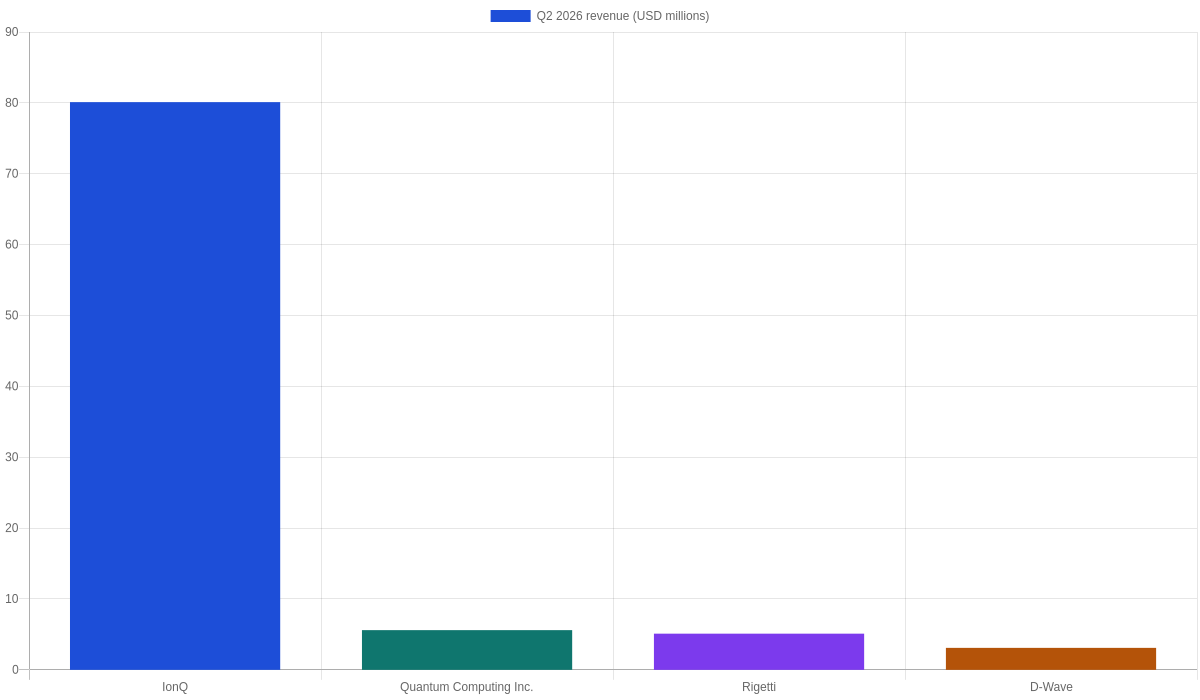
Quantum Computing Inc. reported $5.6 million in Q2 revenue. The company said sales came from quantum and photonics products and services, including government and industrial customers.
Rigetti generated $5.1 million. D-Wave reported about $3.1 million, although its remaining performance obligations reached $40.7 million.
This revenue gap matters because quantum hardware requires sustained engineering spending. Companies without recurring customer demand can remain dependent on capital markets for longer than investors expect.
Four Quantum Stocks Ranked by Commercial Evidence
1. IonQ: The Revenue Leader
IonQ ranks first on commercial evidence. Its Q2 revenue was the largest in this screen, and management raised organic 2026 guidance to $280 million to $290 million before including SkyWater.
IonQ later lifted full-year guidance to $450 million to $460 million after the SkyWater acquisition. The deal broadens the company beyond trapped-ion systems into manufacturing, networking, sensing and security.
The tradeoff is spending. IonQ recorded a $1.87 billion GAAP net loss in Q2, driven partly by noncash accounting items. Its adjusted EBITDA loss was $120.3 million.
2. D-Wave: Bookings Ahead of Recognized Revenue
D-Wave ranks second because its contracted-demand indicators exceed current revenue. The company reported $40.7 million in remaining performance obligations at June 30.
Management expects about 57% of that balance to become revenue within 12 months. That conversion rate will be a key test of demand for its annealing systems and quantum-computing services.
3. Quantum Computing Inc.: A Photonics Manufacturing Bet
Quantum Computing Inc. ranks third. Revenue grew from $61,000 a year earlier to $5.6 million, helped by a wider photonics and semiconductor manufacturing portfolio.
The company ended June with $1.3 billion in cash, equivalents and investments. It also reported $42.5 million of backlog, giving investors two measurable figures to track against future revenue.
The main risk is acquisition-heavy growth. QCi spent roughly $180 million on acquisitions and related costs during the first half, while operating expenses reached $21.8 million in Q2.
4. Rigetti: Hardware Progress With Wider Losses
Rigetti ranks fourth on current commercial scale. Its $5.1 million quarterly revenue remains small beside a $28.1 million operating loss.
Liquidity is less immediate as a concern. Rigetti held $541.3 million in cash, equivalents and available-for-sale investments at quarter-end.
Investors should monitor system deliveries and government-backed programs. Rigetti’s planned U.K. investment and U.S. government support could expand deployments, but orders must still translate into recognized revenue.
Balance Sheets Buy Time, Not Certainty
Each company has funding for continued development. IonQ reported $3.0 billion of cash and investments before accounting for the SkyWater purchase. D-Wave held $546.2 million in cash and marketable securities.
Quantum Computing Inc. held $1.3 billion, while Rigetti reported $541.3 million. Those balances reduce near-term financing pressure, but they do not eliminate dilution, acquisition risk or future cash burn.
Investors comparing these names with adjacent infrastructure plays can review Applied Digital’s AI capacity expansion. It shows how contracted infrastructure demand differs from early-stage quantum commercialization.
The CME compute-futures delay also matters for technology exposure. It shows how new financial products can face regulatory timing risk even when investor demand exists.
For another hardware comparison, the onsemi-Synaptics debt analysis illustrates how acquisitions can reshape both growth and balance-sheet risk.
What Could Move the Group Next
The next earnings cycle will provide the clearest catalyst. Investors should compare reported revenue with remaining performance obligations, backlog and prior guidance rather than focusing only on technical announcements.
IonQ must show that SkyWater expands revenue without worsening adjusted losses. D-Wave needs to convert its RPO balance. QCi must prove that acquired photonics businesses generate repeatable sales, while Rigetti needs system deliveries to outpace operating costs.
For Q4 2026, IonQ has the strongest commercial profile in this four-stock screen. The remaining names offer greater operating leverage if contracts convert, but their lower revenue bases make execution misses more consequential.

Sharron Kendi
Sharron Kendi is a seasoned crypto market analyst and writer with over three years of experience decoding blockchain trends, price movements, and market dynamics. She holds a Bachelor’s Degree in Commerce (Finance) from Kenyatta University, blending a solid academic foundation with a sharp eye for technical analysis and a deep understanding of on-chain data. Her work delivers clear, data-driven insights that empower investors to navigate the fast-evolving digital asset space with confidence.