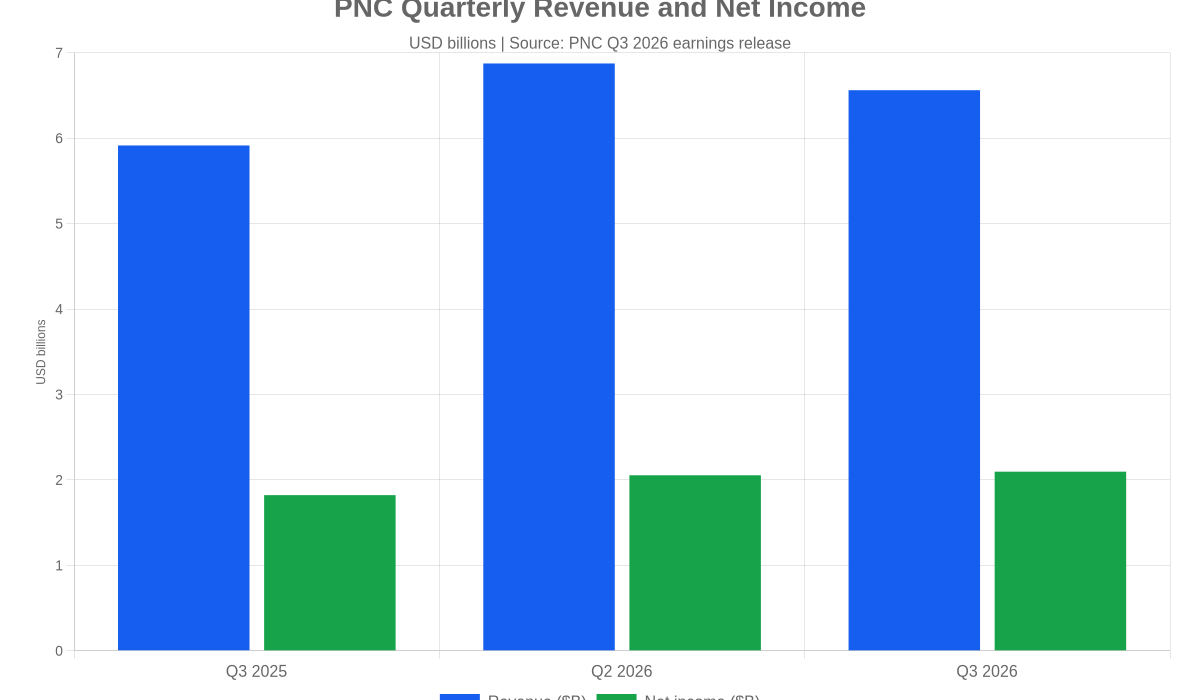
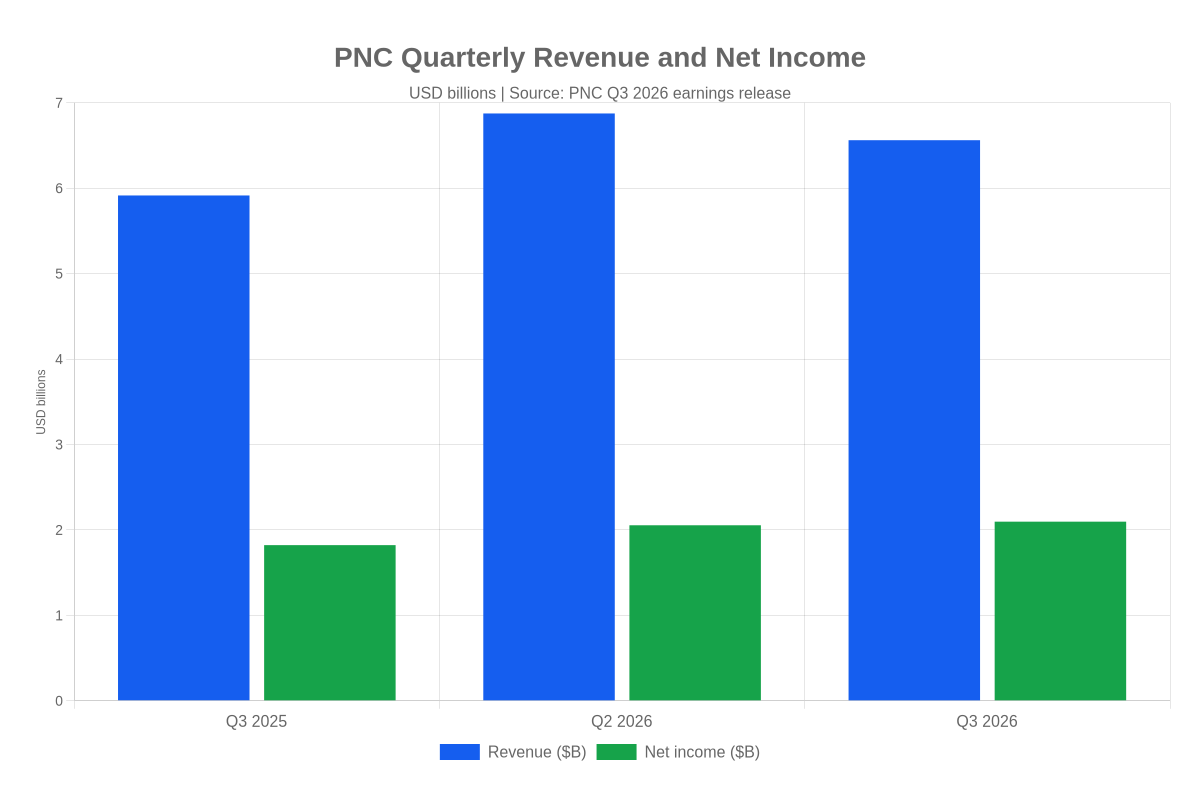
PNC Financial Services reported third-quarter 2026 net income of $2.097 billion, up from $2.055 billion in the second quarter and $1.822 billion a year earlier. Diluted earnings per share reached $4.97, while adjusted EPS was $5.09, according to the bank’s Oct. 15 earnings release.
The results showed a stronger annual trend even as quarterly revenue pulled back. Revenue totaled $6.562 billion, down 5% from the second quarter but 11% above the same period of 2025.
PNC Q3 earnings show stronger annual growth
Net interest income rose 15% from a year earlier and 2% from the prior quarter to $4.206 billion. PNC attributed the quarterly increase to commercial loan growth and higher yields on interest-earning assets, partly offset by higher funding costs. The net interest margin was 2.94%, two basis points below the second quarter but 15 basis points above the year-earlier period.
The chart compares reported revenue and net income across the three reference quarters. It uses PNC’s unaudited earnings-release figures in U.S. dollars.
Loans and deposits expand as fees ease
Average loans increased 2% from the second quarter to $372.2 billion, led by commercial lending. Average deposits rose 1% to $461.2 billion. Those balance-sheet gains helped offset a softer fee result: fee income declined 6% to $2.142 billion, mainly because second-quarter capital-markets and advisory activity had been unusually high.
Other noninterest income fell to $214 million from $489 million. Total noninterest expense declined 8% to $3.751 billion, including $27 million of integration costs, and the efficiency ratio improved to 57% from 60%.
Capital stays firm while charge-offs rise
PNC estimated its common equity tier 1 ratio at 9.8%, compared with 9.9% in the second quarter. The bank returned $1.4 billion to shareholders through $800 million of common dividends and $600 million of share repurchases.
Net loan charge-offs increased to $257 million from $226 million, including $35 million connected to moving a student-loan portfolio to held for sale. Investors comparing bank earnings can also review BlackRock’s third-quarter results, Interactive Brokers’ latest earnings and the September U.S. producer-price report.

Elsy kanana
Elsy Kanana is a financial and cryptocurrency journalist at FusionMarketNews, covering digital assets, blockchain technology, financial markets, and emerging fintech trends. Her reporting focuses on market movements, regulatory developments, and on-chain analytics, delivering clear, data-driven insights to readers worldwide.