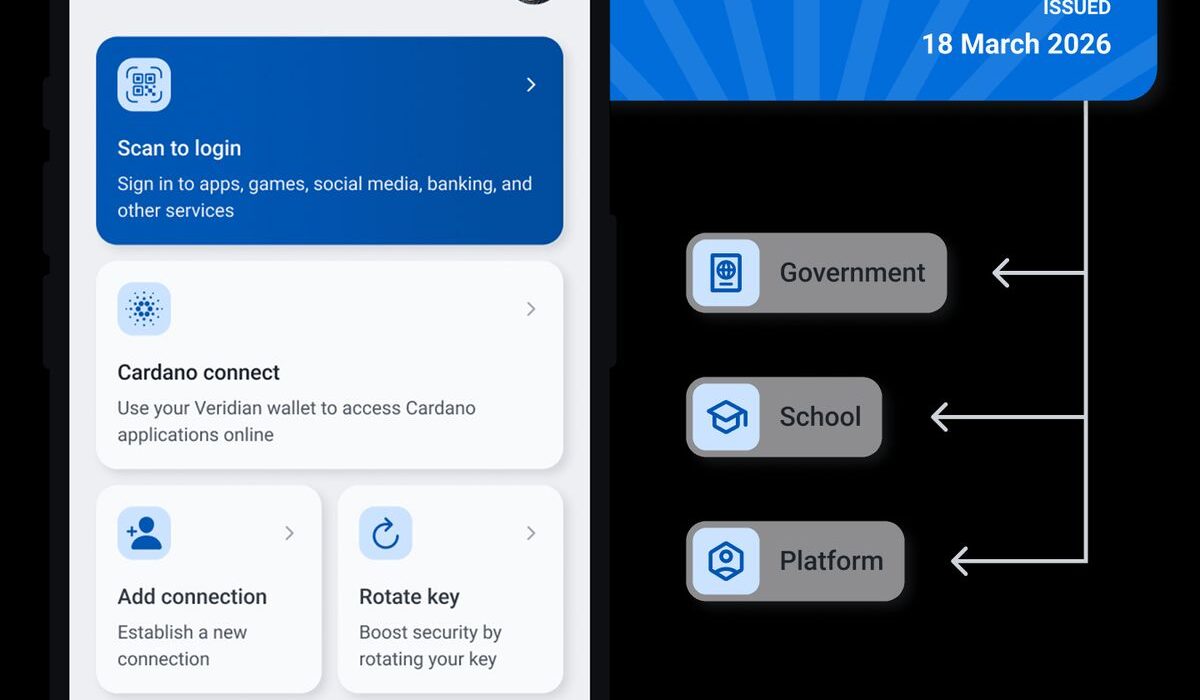
The Cardano Foundation has spun out Veridian as an independent digital identity company, separating the product from its nonprofit incubator. The Veridian spinout also places the company’s shares on Cardano as tokenized Swiss ledger-based securities.
Key Insights
- The Veridian spinout creates an independent commercial company led by CEO Thomas A. Mayfield.
- Veridian’s shares use Cardano’s CIP-0113 standard under Switzerland’s DLT Act.
- The company plans to seek strategic partners and investors in 2027.
The Foundation announced the transaction on October 8, one day after CIP-0113 went live on Cardano’s mainnet. It did not disclose Veridian’s valuation, capitalization, shareholder distribution or the financial terms of the separation.
Veridian Spinout Tests Cardano’s Token Standard
Veridian’s shares have been issued as ledger-based securities under Switzerland’s Distributed Ledger Technology framework, according to the Foundation. The company used CIP-0113, making the equity the first asset deployed through Cardano’s new programmable token system.
CIP-0113 allows issuers to attach compliance controls covering identity checks, sanctions screening and transfer restrictions to native Cardano assets. Fusion previously examined how Cardano programmable tokens enforce those rules at the ledger level.
Digital Identity Becomes the Commercial Focus
Veridian develops identity infrastructure for governments, companies, individuals and AI agents using the KERI and ACDC open standards. Its wallet is available on iOS and Android, while the company said it has mapped all 142 requirements in Utah’s State-Endorsed Digital Identity implementation guide.
The technology is already used by Masumi, a Cardano-based payment and identity network for AI agents, according to the announcement. Veridian assigns verifiable credentials that counterparties can inspect and revoke if an agent is compromised.
Funding and Adoption Are the Next Tests
Veridian plans to seek strategic partners and investors in 2027 as it expands U.S. government work, its European enterprise business and its Asia-Pacific issuer network. The absence of disclosed financial terms means investors cannot yet assess the spinout’s valuation or potential economic benefit to the Cardano ecosystem.
The tokenized-share structure adds a live corporate example to the wider debate over tokenized securities rules. It also differs from consumer-facing projects such as Samsung Wallet’s USDC transfer rollout, because Veridian targets identity credentials and authorization rather than payments.
The next observable catalyst will be disclosure of Veridian’s 2027 funding partners and the terms attached to any capital raise. Adoption by government agencies or enterprises would provide the clearest test of whether the spinout can turn its technical base into recurring commercial demand.

Elsy kanana
Elsy Kanana is a financial and cryptocurrency journalist at FusionMarketNews, covering digital assets, blockchain technology, financial markets, and emerging fintech trends. Her reporting focuses on market movements, regulatory developments, and on-chain analytics, delivering clear, data-driven insights to readers worldwide.