
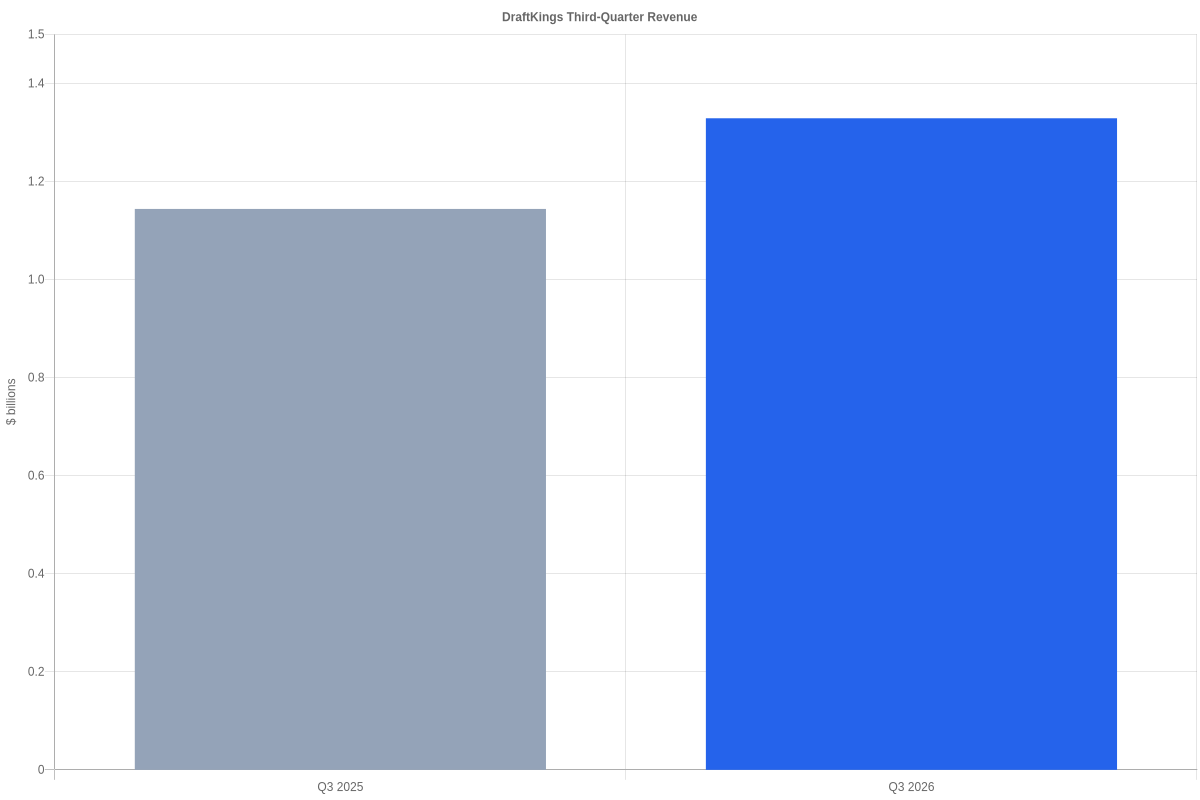
DraftKings reported third-quarter revenue of $1.329 billion, up 16% from $1.144 billion a year earlier, as customer engagement and a higher sportsbook net revenue margin supported growth. The company released the results on November 5, 2026, for the quarter ended September 30; its Form 10-Q was filed with the U.S. Securities and Exchange Commission on November 6.
Prediction spending reshapes the 2026 outlook
DraftKings updated its full-year revenue outlook to $6.35 billion to $6.55 billion. It also projected adjusted EBITDA of $175 million to $275 million, down from the $700 million to $900 million range it maintained after the second quarter, primarily because of added investment in its Predictions business.
The company expects the core business to generate adjusted EBITDA of $875 million to $925 million in 2026. Management said the range also reflects additional spending on iGaming growth and modestly customer-friendly sports outcomes. The distinction matters because the core operation remains profitable on an adjusted basis even as the newer prediction-market push weighs on consolidated earnings.
DraftKings said average revenue per monthly unique payer increased by about $3 to $109. That measure points to stronger monetization, although the company’s higher investment plan means revenue growth will not translate directly into near-term adjusted EBITDA growth.
What investors should watch next
The next test is whether prediction-market spending produces durable customer growth without pushing the profitability timeline farther out. Investors can compare the shift with recent earnings updates from Humana, Brookfield, and Moderna, where guidance changes also shaped the market narrative.
The figures come from DraftKings’ November 5 earnings release and its November 6 Form 10-Q. The release date, filing date and quarter-end date are separate and should not be treated as the same event.

Sharron Kendi
Sharron Kendi is a seasoned crypto market analyst and writer with over three years of experience decoding blockchain trends, price movements, and market dynamics. She holds a Bachelor’s Degree in Commerce (Finance) from Kenyatta University, blending a solid academic foundation with a sharp eye for technical analysis and a deep understanding of on-chain data. Her work delivers clear, data-driven insights that empower investors to navigate the fast-evolving digital asset space with confidence.