

AI Crypto Revenue Gap Widens as NEAR, Bittensor Data Emerges
3 min read
ai crypto
Key Takeaways:
- ai crypto tokens showed rising revenue despite muted market interest
- NEAR protocol revenue trends pointed to long-term valuation gaps
- Bittensor recorded early monetization from active AI subnetworks
The ai crypto sector drew renewed attention in early 2026 as revenue data surfaced across key protocols. Analysts pointed to improving fundamentals in NEAR protocol and Bittensor, even as market participation remained limited. This divergence raised questions about how quickly pricing could reflect underlying growth.
The ai crypto narrative shifted from speculation toward measurable income streams during the current cycle. That transition occurred because several protocols began reporting real usage metrics tied to artificial intelligence services. Market participants, however, remained cautious, reflecting weak sentiment across altcoins despite improving fundamentals.
AI Crypto Valuation Gap Emerges In NEAR Protocol Data
Data shared by Michaël van de Poppe showed that NEAR protocol generated 12 million tokens in revenue during the first four months of 2026. That translated to about $15.6 million over the same period, implying an annual range near $40 million to $60 million.
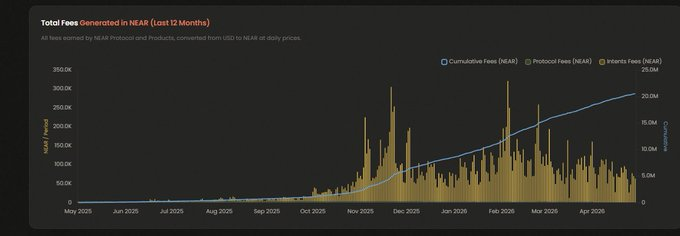
Earlier performance placed total revenue around $10 million before 2026, indicating a steep growth trajectory. This shift occurred because usage expanded alongside token utility within the ecosystem. Van de Poppe projected revenue could approach $500 million to $600 million by 2030 if current growth trends persisted.
Market data showed NEAR traded at $1.28 with a valuation near $1.66 billion during the same period. That implied a price-to-sales ratio close to 34x, which remained below comparable blockchain networks. He compared this level with Solana near 40x and Ethereum near 200x, suggesting relative underpricing based on revenue metrics.
The move followed broader market conditions where investors showed limited interest in ai crypto assets. That reaction mirrored earlier cycles where adoption data lagged behind price discovery. As a result, NEAR protocol appeared to reflect a disconnect between revenue expansion and valuation.
Bittensor AI Crypto Model Showed Active Monetization
Insights from CryptoDoc indicated that Bittensor generated about $43 million in artificial intelligence revenue during the first quarter of 2026. The network operated roughly 128 active subnets, each running live AI services across decentralized infrastructure.
This structure allowed each subnet to function as an independent economy while relying on TAO as the base layer token. The model gained attention because it demonstrated real-time monetization rather than projected growth. CryptoDoc noted that a major subnet exited the network recently without disrupting price stability.
That resilience suggested the ecosystem absorbed structural shifts without triggering broader instability. The system also implemented a post-halving supply schedule, which reduced token issuance over time. This change supported tighter supply dynamics as network activity continued expanding.
Market data placed TAO near $269 with a valuation around $2.9 billion during the same timeframe. These figures reflected growing interest in decentralized AI infrastructure, although broader participation remained limited. The data indicated that Bittensor positioned itself as one of the few ai crypto projects generating consistent income.
AI Crypto Builder Models Shift Toward Revenue-Driven Metrics
Broader market comparisons showed that ai crypto protocols traded below traditional technology firms on a price-to-sales basis. Web2 companies typically ranged between 15x and 30x multiples, depending on growth expectations and profitability outlook.
Van de Poppe noted that artificial intelligence firms like OpenAI and Anthropic traded at higher valuations despite generating less revenue relative to market expectations. This contrast suggested that decentralized protocols faced stricter valuation pressure from investors.
The shift occurred because crypto markets continued prioritizing liquidity cycles over long-term revenue signals. That behavior limited capital inflows into ai crypto despite improving data across several networks. Internet Computer also reflected this pattern, trading near $2.36 with a valuation around $1.3 billion.
Builder activity, however, continued expanding across decentralized AI ecosystems. Protocol designs increasingly focused on utility, revenue sharing, and network-level incentives rather than narrative-driven growth. This transition suggested that ai crypto may rely more on fundamentals during the current market phase.
Outlook
The next phase for ai crypto depended on whether revenue growth translated into sustained capital inflows. Analysts expected NEAR protocol and Bittensor to test higher valuation ranges if adoption trends held. Short-term focus remained on whether investor demand returned as macro conditions stabilized.